

Research Interest
Application of Superhydrophobic and Functional Metal-Organic Frameworks for the Application of Oil-Water Separation and Sensing of Analytes.
Mr. Abhijeet Rana
Prime Minister Research fellow
Department of chemistry
Indian Institute of Technology, Guwahati
Guwahati, 781039
Assam INDIA
+91 9040166787
ACADEMIC PROFILE
Ph.D. (Inorganic and Material Chemistry): Indian Institute of Technology Guwahati.
MSc (Chemistry): Banaras Hindu University, Varanasi, 2020.
BSc (Chemistry), Dharmasala Mahavidyalaya, Utkal University ODISHA, 2017.
Instrument and Sofware Handeling Skills
-
Thermogravimetric analysis Operator
-
FT-IR Spectrometer
-
Fluorescence Spectrometer
-
UV-VIS Spectrometer
-
WinXPow
-
Material Studio
-
Origine
AWARDS
CSIR-NET (JRF): AIR-92 (DEC, 2019).
Prime Minister Research Fellowship (July 2021).
NPTEL Online Course (Biomedical Nanotechnology): Elite Silver Medal.

Research Interests
Application of Superhydrophobic and Functional MOFs
The organic backbone of MOF could be functionalized in various ways to optimize the chemical as well as its physical properties. The fluorinated compound being hydrophobic could be incorporated to the 3D network of MOF by a fluorinated organic linker to get a superhydrophobic MOF. The superhydrophobic property could also be achieved by replacing fluorinated linkers with a long chain hydrocarbon-based linker. The main aim of my research work to use these superhydrophobic MOFs for the preparation of robust composite materials for the application of oil-water separation, emulsion separation, and self-cleaning properties and to develop anti-fouling material. I am also working in the field of chemosensors for the selective detection of various analytes from drinking water with the help of functionalized MOFs.
Ph.D. Supervisor

Dr. Shyam P. Biswas, Associate Professor,
Department of Chemistry, Office Nr. 201,
IIT Guwahati, Assam - 781039, India.
Phone: +91-361-258 3309
E-mail: sbiswas@iitg.ac.in
Publications
1. Functional-Group Assisted Fluorescence Sensing Platform for Nanomolar Level Detection of Antineoplastic Drug and Neurotransmitter from Environmental Water and Human Bio-fluids.
A. Rana, G. Mishra, S. Biswas, Inorg. Chem., 2024, 63, 4502-4510, doi.org/10.1021/acs.inorgchem.3c03341.

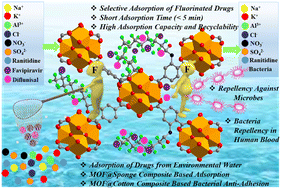
2. Superhydrophobic nanosized metal–organic framework composites for the targeted removal of hydrophobic pharmaceuticals with outstanding bacterial anti-adhesion properties.
S. Ghosh, A. Rana, A. Patel, D. Manna and S. Biswas.
Environ. Sci. Nano, 2024, 11, 1233-1244, doi.org/10.1039/D3EN00747B .
3. The design of a functionalized luminescent MOF sensor for precise monitoring of tuberculosis drug and neonicotinoid pesticides from human body fluids and food samples is to protect health and the environment.
A. Rana, N. U. Mir, A. Banik, A. Hazra and S. Biswas.
J. Mater. Chem. C, 2024, 12, 1030-1039, doi.org/10.1039/D3TC03712F.

4. Metal-Organic Framework-Based Fluorescent Sensors for the Detection of Pharmaceutically Active Compounds.
S. Ghosh, A. Rana and S. Biswas.
Chem. Mater., 2024, 36, 99-13, doi.org/10.1021/acs.chemmater.3c02459.

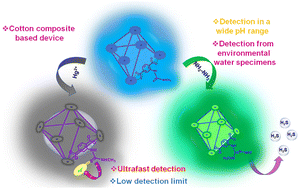
5. Electrophilicity Modulated Targeted Luminescence of MOF Coated Cotton Composite for Dual Analyte Detection in Aqueous Medium.
A. Rana, and S. Biswas.
Inorg. Chem. Front., 2023, 10, 2742-2753, doi.org/10.1039/D3QI00206C.
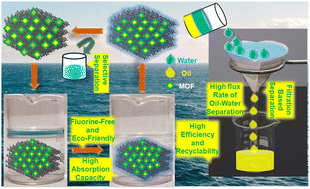
6. An eco-friendly approach by nonfluorous self-cleaning metal-organic framework composite and membrane for oil-water separation.
A. Rana, S. Ghosh, S. Biswas.
Inorg. Chem. Front., 2023, 10, 612-620, doi.org/10.1039/D2QI02062A.
7. A Metal-Organic Framework-Based Chemosensor for Ultrafast and Ultrasensitive Detection of Pd2+ ion in Water, Real Specimens and Test Strip.
P. Chakraborty, A. Rana, S. Mukherjee and S. Biswas.
Inorg. Chem., 2023, 62, 802-809, doi.org/10.1021/acs.inorgchem.2c03318.

8. Hf-Based MOF for Rapid and Selective Sensing of a Nerve Agent Simulant and an Aminophenol: Insights from Experiment and Theory.
S. Ghosh, R. Lipin, A. Ngoipala, N. Ruser, D. Venturi, A. Rana, M. Vandichel and S. Biswas. Inorg. Chem., 2023, 62, 14632-14646, doi.org/10.1021/acs.inorgchem.3c01777.

9. Friedlander condensation reaction catalyzed by the hafnium-based metal-organic framework.
S. Ghosh, J. Krishnan, V. Karthik, A. Rana, A. Dhakshinamoorthy and S. Biswas. Mol. Catal., 2022, 533, 112748, https://doi.org/10.1016/j.mcat.2022.112748.

10. A self-cleaning hydrophobic MOF-based composite for highly efficient and recyclable separation of oil from water and emulsion.
S. Ghosh, A. Rana, S. Kumar, C. Gogoi, S. Mukherjee, U. Manna, and S. Biswas. Mater. Chem. Front, 2022, 6, 2051-2060, DOI: 10.1039/d2qm00289b.
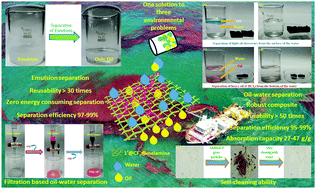
11. Superhydrophobic Self-Cleaning Composite of a Metal–Organic Framework with Polypropylene Fabric for Efficient Removal of Oils from Oil–Water Mixtures and Emulsions.
C. Gogoi, A. Rana, S. Ghosh, R. Fopase, L. M. Pandey, and S. Biswas.
ACS Appl. Nano Mater, 2022, 5, 10003-10014, https://doi.org/10.1021/acsanm.2c02418.

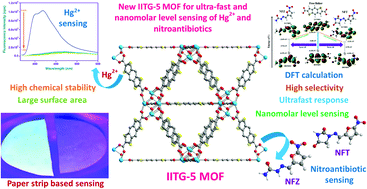
12. A fluorescent zirconium organic framework displaying rapid and nanomolar level detection of Hg(ii) and nitroantibiotics.
S. Ghosh, F. Steinke, A. Rana, and S. Biswas.
Inorg. Chem. Front., 2022,9, 859-869, doi.org/10.1039/D1QI01190A.
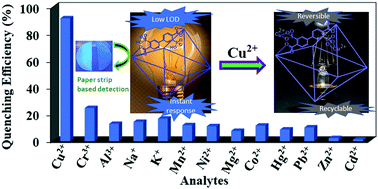
13. Sulfonic acid functionalized zirconium-based metal–organic framework for the selective detection of copper(II) ions.
A. Rana, S. Nandi, and S. Biswas.
New J. Chem., 2022, 46, 10477-10483, DOI: 10.1039/D2NJ01068B.
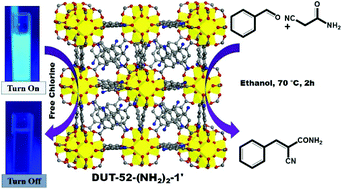
14. Diamino group-functionalized Zr-based metal–organic framework for fluorescence sensing of free chlorine in the aqueous phase and Knoevenagel condensation.
C. Gogoi, N. Nagarjun, A. Rana, A. Dhakshinamoorthy and S. Biswas.
Dalton Trans., 2022,51, 6964-6975, doi.org/10.1039/D2DT00194B.
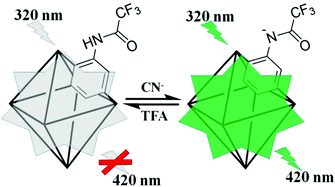
15. Rapid recognition of fatal cyanide in water in a wide pH range by a trifluoroacetamido based metal–organic framework.
A. Rana, C. Gogoi, S. Ghosh, S. Nandi, S. Kumar, U. Manna and S. Biswas.
New J. Chem., 2021,45, 20193-20200, doi.org/10.1039/D1NJ04278E.
16. A metal-organic framework with allyloxy functionalization for aqueous-phase fluorescence recognition of Pd(II) ion.
S. Ghosh, F. Steinke, A. Rana, M. Alam, S. Biswas
Eur. J. Inorg. Chem., 2021, 3846, doi.org/10.1002/ejic.202100568.
